Recruiting that compounds instead of resets.
Most tools help you start another search. Ryger turns every resume you touch into a recruiting network you own — one that grows with every role and surfaces the right people before you start sourcing.
The best recruiting work should not disappear when a role closes.
Every new role starts from zero.
Open a req and the clock resets: build the search, source the list, screen the resumes, start conversations from cold. You did most of this work last month — but when the role closed, the network you built around it closed with it.
So the next role begins exactly where the last one started. From scratch. The hours don’t add up to anything you can reuse.
Each role spikes, then resets to zero. The work you did doesn’t carry to the next req.
Each role adds to a network you own. Every search starts further ahead than the last.
Build a recruiting network you own — and reuse it on every role.
Ryger keeps the work. Every resume you collect becomes a structured candidate in a network that’s yours — not a filing cabinet locked inside one employer’s ATS, but a recruiting asset that follows you across roles and clients. Fill one role and you’ve made the next one easier. Do it ten times and each new search starts against a thousand candidates you’ve already sourced.
100
candidates
in your network
500
candidates
in your network
1,000
candidates
in your network
A recruiting network you own — and it grows with every role.
Every resume strengthens it. By your tenth role, each new search starts against a thousand candidates you've already sourced.
Your own branded page — candidates join your network, not a black hole.
Most applications vanish into a company ATS the moment a role closes. Ryger gives you a branded recruiter page that works like a mini job board: candidates submit directly to you and become part of your network — available for this role and every role after it.
Independent recruiters build their own network. Agencies build a shared one. Recruiters inside an agency can do both. However you work, the network belongs to your side of the table.
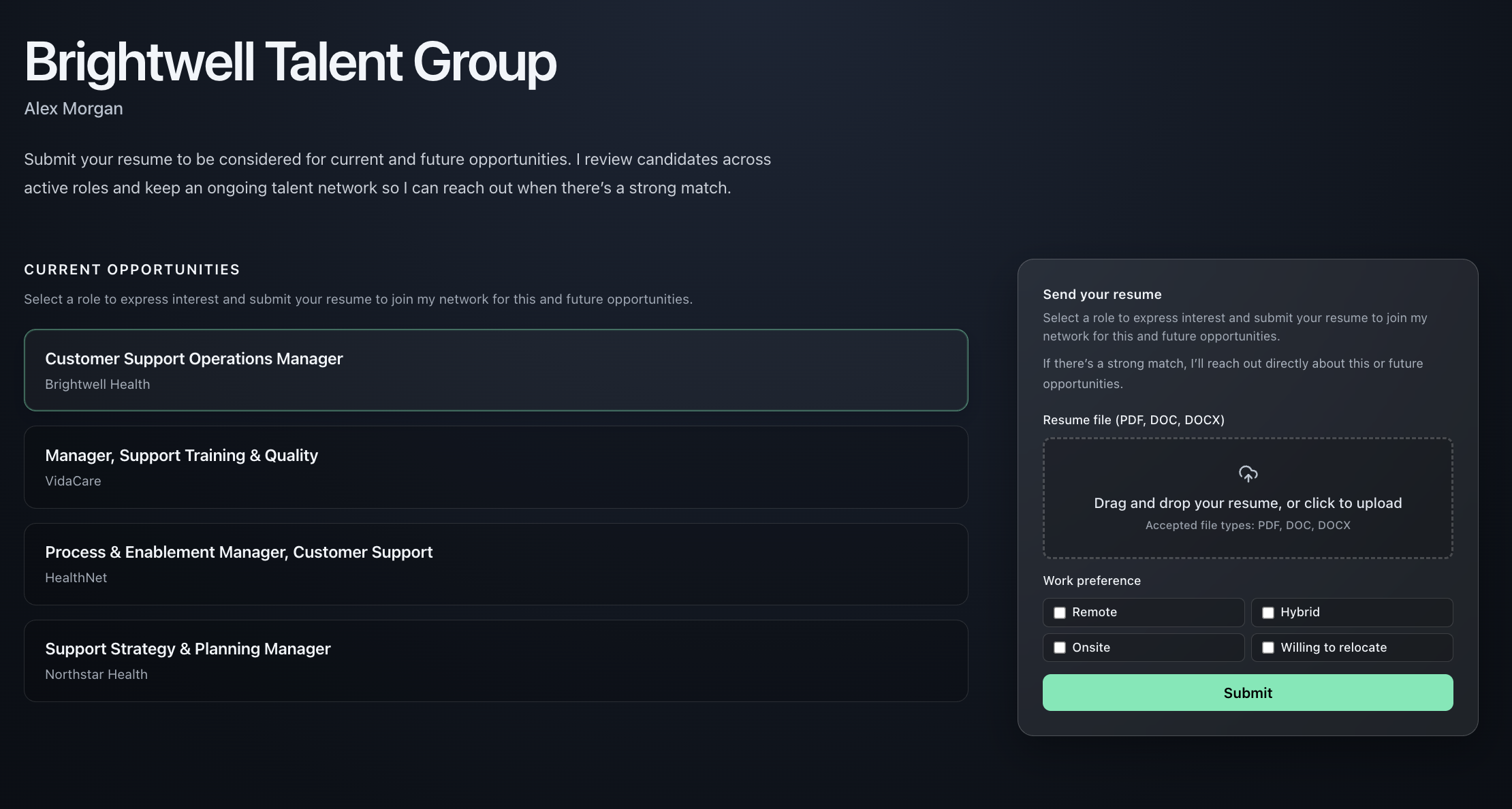
The network grows from work you’re already doing.
A network you own sounds great once it’s full — but Ryger pays off long before that. You don’t build it as a separate chore. It fills as a byproduct of normal recruiting, and the first payoff comes on your second similar role — not a year from now.
Seed it in minutes
Upload the resumes already in your inbox — ~20 in 30 seconds — and point your branded page at your open roles.
A similar req opens
You open your next opening the way you always do — except now there’s a network sitting behind it.
Candidates already waiting
The people you screened for the first role surface for the second — before you build a single search.
Open a role. Your strongest matches are already there.
Nothing about your day gets more complex — it gets shorter. Instead of starting a role with a blank search, you start it with a shortlist. Ryger evaluates your whole network the moment a role opens, and keeps matching continuously as new roles are created. Search still matters. It just stops being where every role begins.
New role arrives
Senior Frontend Engineer
Stripe · Remote
Your 1,000 structured profiles
12 already waiting
Outreach begins in less time than it takes to build a search.
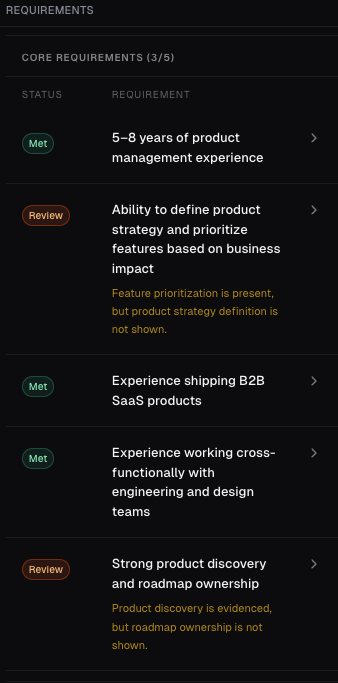
Evidence you can see — and a network worth reviewing.
Every match comes back requirement by requirement, with evidence pulled from the candidate’s actual background — met, review, and gap — never a black-box score. Ryger reads resumes for what they contain, so strong people don’t get filtered out for missing a keyword. You stay in control; the AI explains its reasoning instead of deciding for you.
And because Ryger is built for signal over volume — people who intentionally joined your network, not mass-applied noise — the candidates you’re reviewing are worth the time it takes to review them.
Stop starting over. Start compounding.
Every resume, every role, and every conversation makes your network stronger — so your next search starts further ahead than your last.
A network you own.·Clearer signal.·Better-fit hiring.